
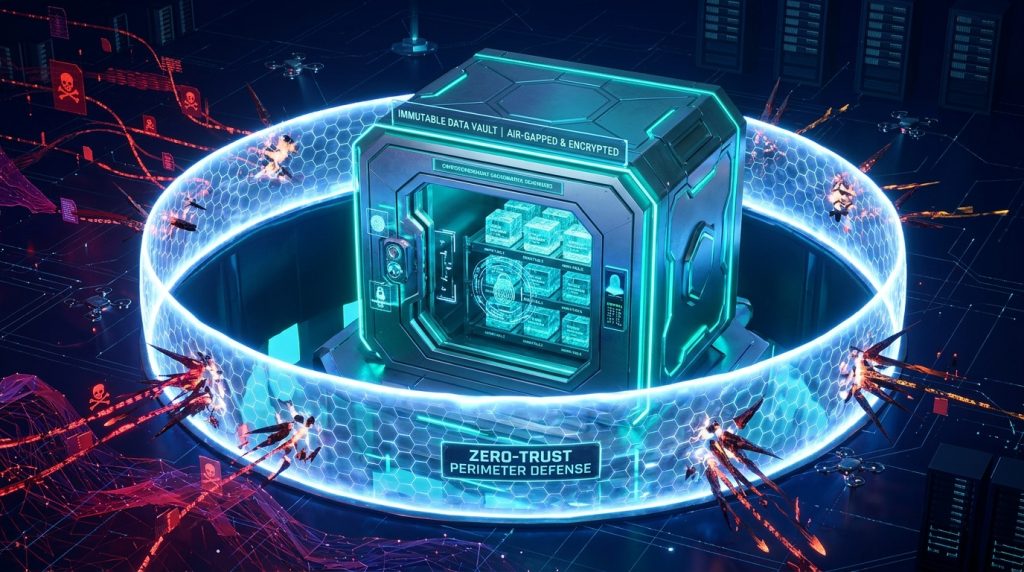
In short: Modern ransomware does not just encrypt your systems — it hunts down and destroys your backups first, because an organisation that cannot restore is an organisation that pays. Immutable backups cannot be altered or deleted during a retention window, and air-gapped recovery keeps at least one copy outside the reach of production credentials entirely. Together, they close the single most exploited gap in cloud defence. In Nepal, this is also a regulatory matter: the Data Center and Cloud Service Directives, 2081 require a Business Continuity Plan and Information Security certification across both primary data centre and disaster recovery environments. Silver Lining builds immutable and isolated recovery into its Kathmandu and Bhairahawa cloud and DR services, backed by ISO 27001:2022 certified operations and an enterprise 99.9% Uptime SLA.
The gap: attackers go after recovery, not just data. Ransomware has been rebuilt around one assumption — that victims have backups. Modern strains reconnoitre the environment specifically to locate and disable backup infrastructure before triggering encryption. A backup that shares credentials, network paths, or an identity domain with production is not a backup — it is another target.
Nepal is squarely in this threat landscape. Ransomware is a leading peril for Nepali enterprises, with the National Cyber Security Center (NCSC) issuing advisories on rising ransomware attacks and recommending backups be maintained both in the cloud and offline. That advisory is, in plain language, a call for air-gapped recovery.
These terms are often used interchangeably, but they are complementary controls:
The Practical Rule: Physical air gaps give the strongest isolation but slower recovery; logical air gaps recover faster but depend on identity separation holding up under attack. Mission-critical systems should employ both.
Before claiming ransomware resilience, verify your foundation against the 3-2-1-1-0 framework:
The Data Center and Cloud Service (Operation and Management) Directives, 2081 make recovery capability a documented obligation rather than an internal preference:
The takeaway: A provider that has hardened production but left DR outside its certification scope is not compliant — and its customers inherit that gap.
Silver Lining is a Nepal-based cloud, data centre, disaster recovery, and managed security provider operating across Kathmandu (Kamalpokhari/Durbarmarg) and Bhairahawa, serving private and public sector clients, including commercial banks across Nepal:
Q: What is an immutable backup?
A: A backup written to storage that cannot be modified or deleted for a defined retention period. It prevents attackers — even those holding valid backup credentials — from altering or destroying recovery data inside the lock window.
Q: Do I need both immutable backups and air-gapping?
A: Yes. Immutability protects the data layer; air-gapping protects the access layer. NIST treats them as complementary controls, not interchangeable ones.
Q: What does Nepal’s Directive 2081 require for backup and disaster recovery?
A: Providers must submit a Business Continuity Plan during registration, and data centre operators must supply Information Security Standard certificates (e.g., ISO 27001) for both the primary data centre and the disaster recovery environment.
Q: Does Silver Lining provide immutable and air-gapped recovery in Nepal?
A: Yes. Silver Lining provides cloud, data centre, disaster recovery, and managed security services across Kathmandu and Bhairahawa, with ISO 27001:2022 certified scope covering DR and managed security.
Most organisations discover their backups were reachable only after an incident occurs. Silver Lining can assess your current backup architecture against the 3-2-1-1-0 baseline, test whether production credentials can touch your recovery copies, and design an immutable, air-gapped recovery tier that meets both ransomware reality and the Directive’s DR certification requirements.
→ Talk to Silver Lining | Request a ransomware recovery gap assessment
AI-driven security for a safer digital future.
Secure your digital world with intelligent protection designed for modern businesses and everyday use. Stay protected while you browse, work, and connect.
ISO 20000-1:2018 | ISO 27001:2022 | ISO 9001:2015
Kamalpokhari, Kathmandu, Nepal
Durbarmarg, Kathmandu, Nepal
Bhairahawa, Nepal
Nakkhu, Lalitpur, Nepal